Registration successful
 Account activated – pending validation.
 Your account has been activated successfully, but we still need to validate you as a healthcare professional. We’ll send you an email with the result of the validation process in the next three days.
 In the meantime, you can enjoy access to all the latest news, events and resources for different therapy areas on our website.

Postherpetic neuralgia (PHN)
- Affects up to 30% of patients with shingles9*
- Characterized by long-lasting nerve pain that can persist for years5
Not a healthcare professional? Visit our Public site
Not a healthcare professional? Visit our Public site

59


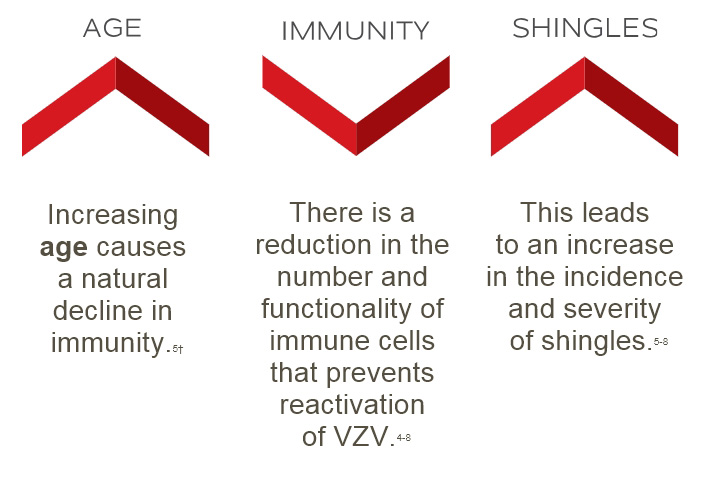
Increasing age causes a natural decline in immunity.5†

There is a reduction in the number and functionality of immune cells that prevents reactivation of VZV.4-8

This leads to an increase in the incidence and severity of
shingles.5-8
99.5% of people ≥50 years old are at risk for developing shingles.5*
One out of 3 people will get shingles in their lifetime.5*


99.5% of people ≥50 years old are at risk for developing shingles.⁵*
One out of 3 people will get shingles in their lifetime.⁵*

Shingles can be painful and can lead to serious, long-lasting complications5:

Learn more about the design of SHINGRIX5-7, 11-15
Discover the cause of shingles and see how SHINGRIX works to directly address it.
*US data. May not be representative of global population.
†Immunocompromise, caused by immunosuppressant drugs or immunodeficient conditions, may also cause immune system decline.
CDC=Centers for Disease Control and Prevention; VZV=varicella zoster virus.
Shingrix Safety Information16
Contraindications:
Hypersensitivity to the active substances or to any component of the vaccine.
Special warnings and precautions:
As with all injectable vaccines:
- appropriate medical treatment and supervision should always be readily available in case of an anaphylactic event following the administration of the vaccine;
- vaccination with Shingrix should be postponed in subjects suffering from an acute severe febrile illness. The presence of a minor infection, such as a cold, should not result in the deferral of vaccination;
- a protective immune response may not be elicited in all vaccinees.
Do not administer the vaccine intravascularly, intradermally or subcutaneously.
There are no data on the use of Shingrix in pregnant women and the effect on breast-fed infants of administration of Shingrix to their mothers has not been studied.
Adverse reactions:
- Very common (≥1/10): headache, gastrointestinal symptoms (including nausea, vomiting, diarrhoea and/or abdominal pain), myalgia, injection site reactions (such as pain, redness, swelling), fatigue, chills, fever.
- Common (≥1/100 to <1/10): injection site pruritus, malaise.
Please refer to the full prescribing information for further details.
References
For more information, please refer to the prescribing information or contact GSK: P.O Box 55850, Jeddah, 21544, Kingdom of Saudi Arabia.
Telephone: +966 12 653 6666 or via gcc.medinfo@gsk.com
To report Adverse Event/s associated with the use of GSK product/s, please contact us via saudi.safety@gsk.com
To report the Quality related product complaint/s associated with the use of GSK product/s, please contact us via ksa.productqualitycomplaint@gsk.com
GSK does not recommend, endorse or accept liability for sites controlled by a third party.
Trademarks are property of their respective owners.
©2023 GSK group of companies or its licensor
GlaxoSmithKline, Jeddah, 21544, Kingdom of Saudi Arabia.
PM-SA-SGX-WCNT-220001 Date of preparation: August 2023

Please update your operating system or use a different device.